

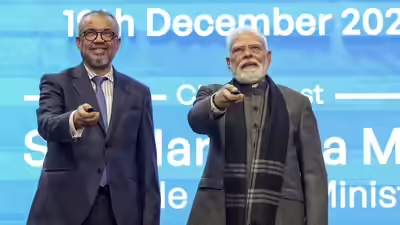
New Delhi: Prime Minister Narendra Modi on Friday brought traditional medicine into the global healthcare spotlight with the launch of the Traditional Medicine Global Library (TMGL), an international digital platform designed to support research, policymaking and evidence-based healthcare practices related to ancient medical systems such as Ayurveda and Yoga.
Speaking at the valedictory session of the Second WHO Global Summit on Traditional Medicine at Bharat Mandapam, the Prime Minister said the initiative delivers on a promise made during India’s G20 presidency. The TMGL will consolidate scientific studies, research findings and policy documents on traditional medicine into a single, accessible global repository. He emphasised that the platform will enable fair and reliable access to verified information for nations across the world.
With contributions from 194 countries, the TMGL represents a transition from scattered, region-specific knowledge to a unified global knowledge base. This shift is expected to strengthen evidence-driven research, improve regulation and support the safe integration of traditional medicine into national healthcare systems.
Modi noted that the three-day summit demonstrated a meaningful blend of tradition and modern innovation, with discussions covering research methodologies, digital solutions, artificial intelligence, global standards and investment opportunities. These deliberations, he said, resulted in the Delhi Declaration, which will act as a shared framework for collaboration in areas such as safety, quality standards and professional training.
Underscoring India’s role in advancing traditional medicine globally, the Prime Minister expressed pride in hosting the WHO Global Centre for Traditional Medicine in Jamnagar. He also inaugurated the new WHO South-East Asia Regional Office Complex in Delhi, describing it as an important centre for research, regulation and capacity development.
Connecting traditional medicine to contemporary health issues, Modi highlighted how lifestyle-related imbalances are contributing to rising cases of diabetes, cardiovascular diseases, depression and cancer. Restoring physical and mental balance, he said, has become a pressing global necessity.
The Prime Minister announced initiatives aimed at strengthening integrative cancer care, combining traditional medical systems with modern treatment approaches. He also referred to ongoing clinical research in areas such as anaemia, arthritis and diabetes, along with increasing innovation driven by Indian start-ups in the health sector.
During the event, Modi launched several major Ayush initiatives, including the My Ayush Integrated Services Portal and the Ayush Mark, envisioned as an international quality standard. He also released a WHO technical report on yoga education and honoured the recipients of the Prime Minister’s Awards for Outstanding Contribution to the Promotion and Development of Yoga, acknowledging their efforts in expanding yoga’s global reach.